Dual-Level Structural Decomposition for Bimanual Robot Manipulation
DONGGUK UNIVERSITY · iROBOTLAB
* Corresponding author
The stage structure of real-world task R2: pick bottle → handover → pick & bring cup → pour → return. As the task unfolds, the relevant wrist view and the interaction mode shift together. We route both explicitly — what to see at the perceptual level and how to act at the action level — instead of folding them into one shared pathway.
Abstract
In bimanual robotic manipulation, the task-relevant visual information varies with the task stage and context, while the interaction of the two arms shifts between independent and coordinated modes — making policy learning hard. Existing monolithic Vision-Language-Action (VLA) policies push diverse visual inputs and interaction patterns through a single shared representation and action pathway, often failing to separately account for visual relevance and bimanual interaction structure.
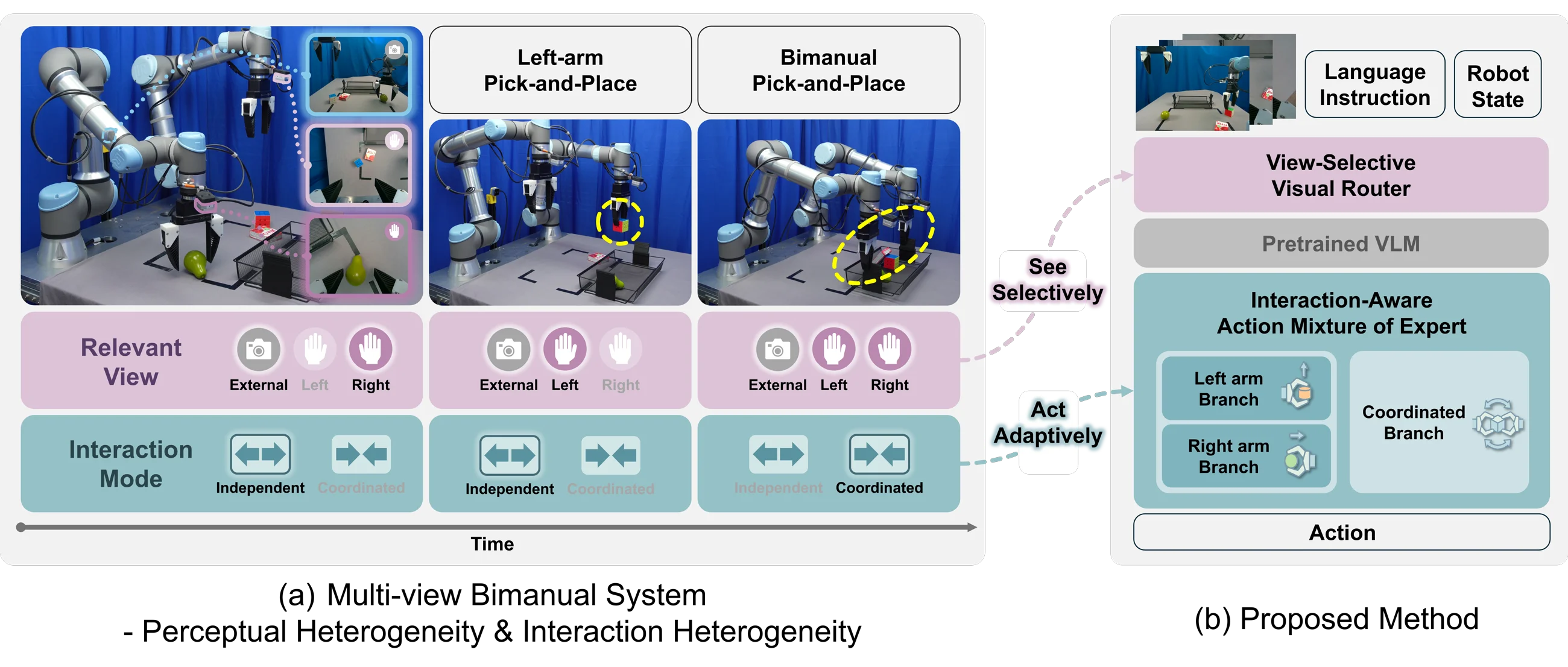
We propose a bimanual VLA framework based on Dual-Level Structural Decomposition. The View-Selective Visual Router dynamically adjusts wrist-view contributions to emphasize relevant cues, while the Interaction-Aware Action Mixture-of-Experts decomposes action generation into coordinated and arm-wise pathways to adapt to varying interaction modes.
Across six simulated tasks in RoboTwin 2.0 and three long-horizon real-world tasks, our model improves the overall average success rate over a monolithic baseline by 27.7% in simulation and 43.3% in the real world, while consistently outperforming single-module variants in both settings.
The Challenge
When both arms are in play, the visual information you need changes across stages, and dependencies arise between the arms. We frame this as two intertwined forms of heterogeneity.
When the left arm grasps, its wrist view carries the critical cue — while the right wrist view becomes a distractor. Monolithic policies aggregate all views without accounting for this time-varying relevance, weakening the signals that matter.
Some stages need independent motion; others need tightly coordinated motion toward a shared goal. Learning both inside one shared action pathway entangles mode-specific signals and biases the policy toward a single interaction mode.
Method
We build on the pretrained VLA model π0.5 and augment it with two structural modules — one at the perceptual input stage, one at the action expert — leaving the rest of the pipeline intact.
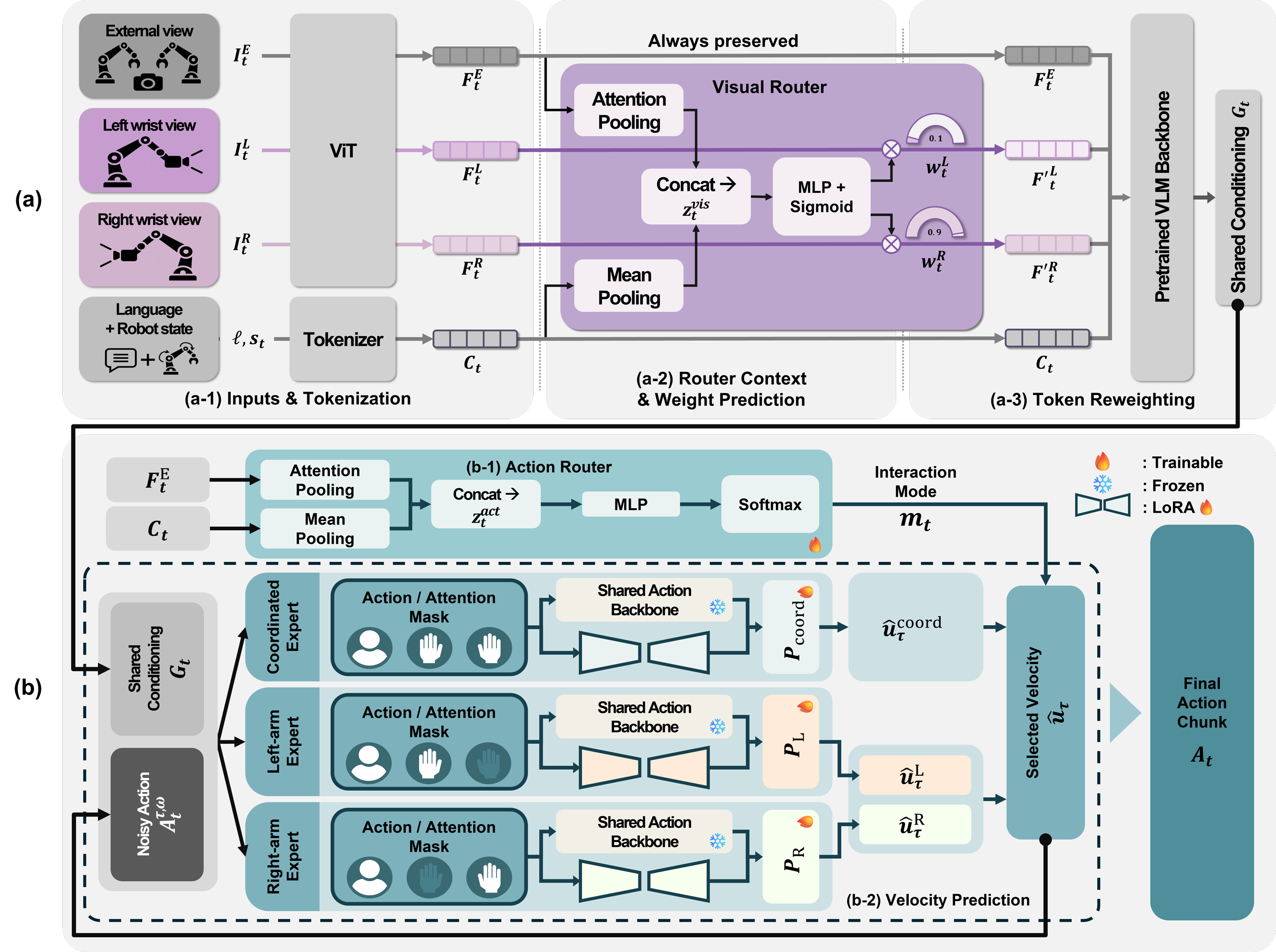
Predicts per-view relevance weights for the two wrist views and reweights their visual tokens before the VLM — incorporating view relevance at the input stage rather than relying only on the backbone's internal attention.
Generates actions via conditional flow matching with three LoRA-based experts. An Action Router picks a hard interaction mode, and the selected branch predicts the velocity field for the action chunk.
Both routers are trained with labels from a KNN-based two-pass semi-automatic procedure: ~10% of episodes are hand-annotated as a reference set, propagated to the rest using proprioceptive features, then refined with a boundary-focused second pass. Held-out frame accuracy reaches 0.9977 (view relevance) and 0.9988 (interaction mode). The total objective combines flow-matching action loss, router supervision (BCE + CE), and a decaying per-expert auxiliary loss.
Results
In both simulation and the real world, the full model outperforms the monolithic baseline and both single-module variants on average. A parameter-matched LoRA 2× baseline shows no gain in simulation and still trails Ours in the real world — the improvement comes from the decomposition, not extra parameters.
| Method | S1 Stack Bowls | S2 Blocks Rank | S3 Lift Pot | S4 Bread Skillet | S5 Handover | S6 Bottles Bin | All | ||||||
|---|---|---|---|---|---|---|---|---|---|---|---|---|---|
| E | H | E | H | E | H | E | H | E | H | E | H | Avg | |
| Baseline (π0.5) | 67 | 36 | 27 | 10 | 97 | 47 | 63 | 8 | 69 | 9 | 46 | 24 | 41.9 |
| w/o IAMoE | 71 | 45 | 50 | 47 | 95 | 70 | 65 | 29 | 75 | 21 | 51 | 32 | 54.3 |
| w/o VSR | 78 | 50 | 49 | 33 | 99 | 75 | 70 | 38 | 86 | 33 | 65 | 40 | 59.7 |
| Ours | 85 | 68 | 63 | 55 | 97 | 83 | 78 | 47 | 93 | 46 | 71 | 49 | 69.6 |
| Task | Easy | Hard (unseen) | ||||
|---|---|---|---|---|---|---|
| Baseline | w/o IAMoE | w/o VSR | Ours | Baseline | Ours | |
| R1 · Pack and Place | 40 | 40 | 60 | 90 | 10 | 40 |
| R2 · Handover and Pour | 60 | 80 | 90 | 100 | 20 | 60 |
| R3 · Rotate and Place | 30 | 50 | 60 | 80 | 10 | 60 |
Robustness under the hard setting. When environmental variation introduces visual ambiguity, explicit routing helps most — Ours improves over the baseline by 35.7% on average in simulation, and by up to +50% on real-world tasks. The routers are not merely fitting easy-setting correlations.
Qualitative Results
Each long-horizon task switches relevant wrist view and interaction mode repeatedly within a single rollout. Use the Easy/Hard toggle on each card to compare settings with a larger view.
Sequentially pack objects, then jointly transport the box.
Hand the bottle between arms, grasp the cup, pour.
Realign the rotated cube layer, place on matched plates.
Six tasks span pronounced perceptual heterogeneity (S1, S2), pronounced interaction heterogeneity (S3, S4), and both at once (S5, S6). Toggle each card between Easy and Hard.
Live router outputs during a real-world rollout of Handover and Pour: the three camera views with per-view relevance weights, the Visual Router tracing left/right wrist-view relevance, and the Action Router switching between coordinated and independent modes.
Citation
@article{choi2026see,
title = {See Selectively, Act Adaptively: Dual-Level Structural
Decomposition for Bimanual Robot Manipulation},
author = {Choi, Yoon-Ji and Son, Young-Chae and Lim, Soo-Chul},
journal = {arXiv preprint arXiv:2606.13279},
year = {2026}
}